


HYROX Doubles: Exact Station Splits by Partner Type
HYROX Doubles is the fastest growing division, not just because you can sign up with a friend, but elite athletes are using the format to push harder, faster, and more intense.
One of the great things about HYROX Doubles is that when it goes well - you and your partner have figured out your changeovers, agree on who handles the sandbag lunges and who starts the wall balls - when you cross the finish line with a partner, it is one of the more satisfying athletic experiences available to a person.
Let's cover how divisions and weights work, how reps are split between partners, whether doubles is actually harder than solo, how many burpees you're really signing up for, the most common mistakes teams make, and what the 3-3-3 rule means for your training.

HYROX Doubles? The Format Explained
In HYROX Doubles, two athletes race the entire course together as a team. Both partners run every single kilometer side by side. There is no splitting the runs, and no taking turns on the track. You run together, and you must stay within 15 seconds of each other at all times or face a time penalty.
Partners can divide the workload at each station in any ratio they choose.
There is no rule requiring a 50/50 split.
One partner can do more at a station they are stronger at. One partner can, theoretically, complete an entire station while the other one stands on the doubles mat and recovers. The division is entirely up to the team.
Here is the full station breakdown and the total shared workload:
Station 1 - SkiErg: 1,000 meters total between partners
Station 2 - Sled Push: 50 meters total
Station 3 - Sled Pull: 50 meters total
Station 4 - Burpee Broad Jumps: 80 meters total
Station 5 - Rowing: 1,000 meters total
Station 6 - Farmers Carry: 200 meters total
Station 7 - Sandbag Lunges: 100 meters total
Station 8 - Wall Balls: 75 or 100 reps total, depending on division
The numbers above represent the total shared workload for the team. Your job is to divide them in whatever way gives you the best chance of finishing fast without one or both of you completely falling apart.
HYROX Doubles Divisions, Weights, and Age Groups
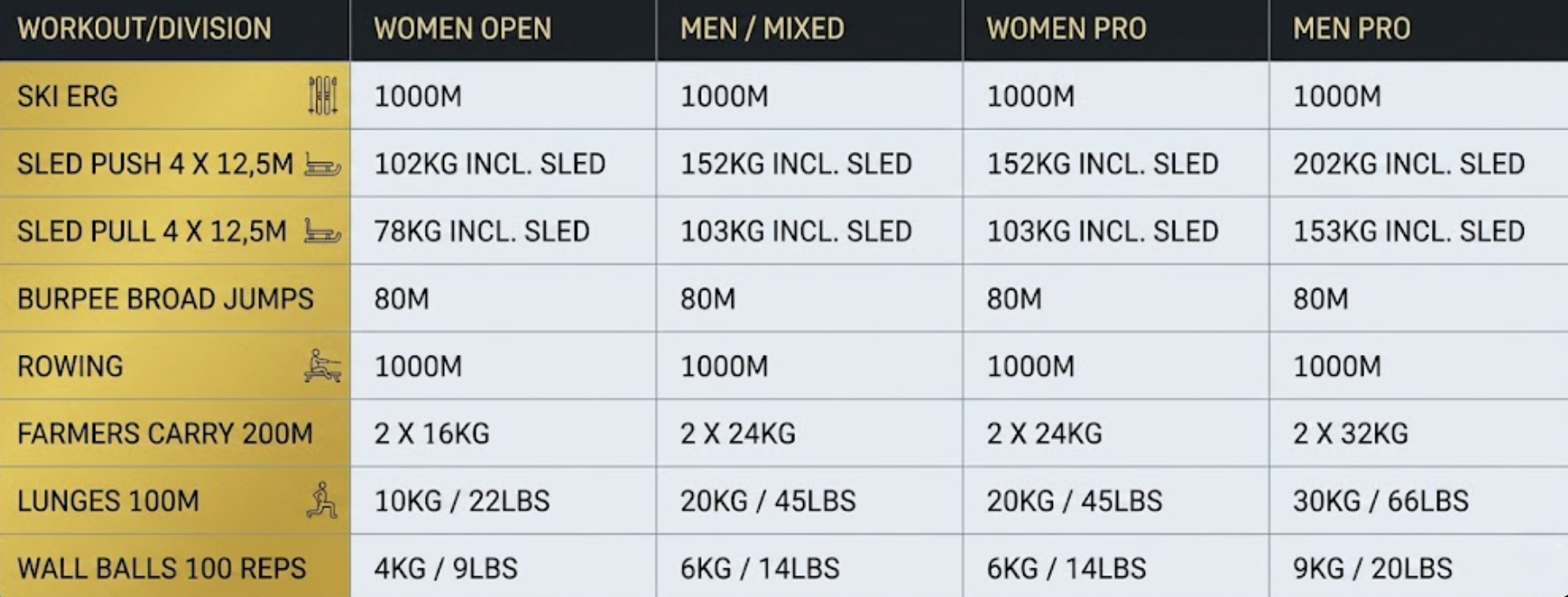
The five competitive divisions are:
Open Male-Male: all stations at male open weights
Open Female-Female: all stations at female open weights
Open Mixed Male-Female: all stations at male open weights
Pro Male-Male: all stations at pro male weights
Pro Female-Female: all stations at pro female weights
A note on mixed doubles: the female partner in a mixed team works with male open weights across all stations. If you are a woman entering a mixed doubles team, you are working heavier than you would in an open female-female pairing. Plan your training accordingly.
Age groups are determined by averaging the ages of both partners at the time of the event. If one partner is 28 and the other is 36, the average is 32, which puts the team in the 30-34 bracket. The bands run from 16-24 all the way through 70-plus, in five-year increments.
One more thing for the competitive athletes: at the HYROX World Championships, same-sex doubles teams compete at pro weights rather than open weights, with an exception for athletes over 60. If you are training with your eye on Worlds, make sure the weights in your training sessions reflect what you will actually face on that day.

Is HYROX Doubles Split? Understanding the Rep Division Rules
Yes, it is split. How it is split is entirely up to you and your partner:
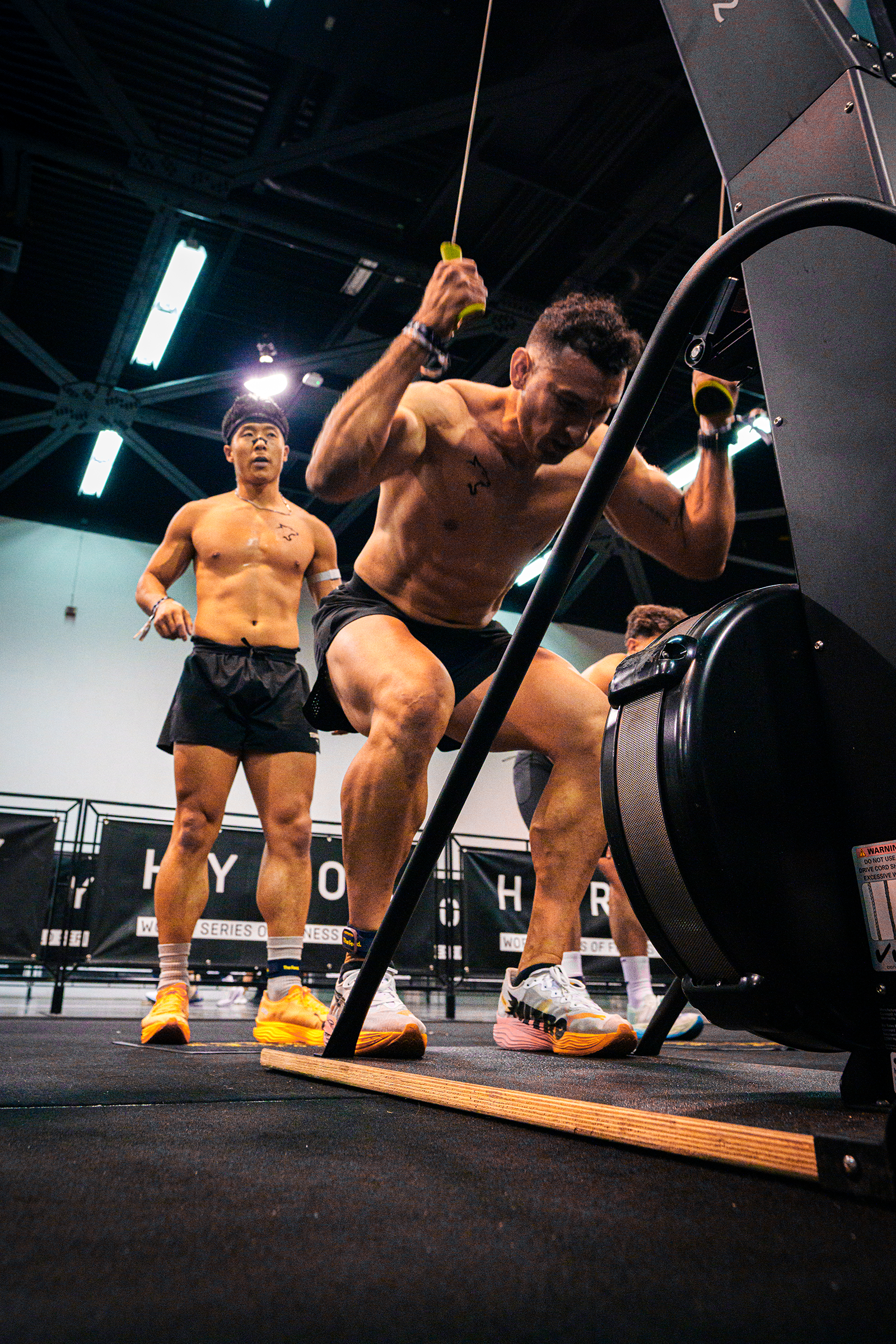
SkiErg: Only one partner uses the machine at a time. The non-working partner stands on the designated doubles mat and cannot touch the erg. Handles must be released and re-gripped from the machine - you are not permitted to hand them directly to your partner.
Sled Push: The non-working partner follows directly behind the pushing partner, not in front and not in a separate lane. Both partners must follow the sled to each end of the track.
Sled Pull: Only the working partner stands on the pulling box. The other stays directly behind. Only the pulling partner may handle the rope.
Burpee Broad Jumps: One partner works while the other waits behind. Transitions can happen side by side or by the incoming partner stepping forward through the working partner's legs, which sounds undignified and in practice very much is.
Rowing: One partner rows their full portion while the other waits on the doubles mat without touching the machine. The foot straps must be tightened by the athlete getting in - the partner on the mat is not allowed to do it for them.
Farmers Carry: The non-working partner walks directly behind. Kettlebells can be set down and picked up from that position.
Sandbag Lunges: The non-working partner walks behind the lunging partner. The sandbag cannot touch the floor during the transition. Back-to-back transfer works well for partners of similar height; an overhead pass tends to work better when there is a significant height difference.
Wall Balls: The non-working partner stands in the rig facing their partner. The ball can be passed forward at waist height or dropped to the floor for the incoming partner to collect.
Know these before you race. A penalty for a transition violation is a deeply demoralizing thing to explain to your partner.

Is HYROX Doubles Harder Than Individual HYROX?
For HYROX first-timers, this becomes dramatically less frightening since you have the option to rotate on reps, instead of grinding through the full count alone.
However, for the run section in doubles, you run at your partner's pace. You must stay within 15 seconds of each other across every kilometer of the race. If your partner is the slower runner, you are spending energy on patience and restraint rather than performance. If your partner is the faster runner, you are spending energy you do not have just to keep up.
Communication adds a layer of work, where you are making real-time decisions about when to swap, how many more reps you can honestly take, and whether your partner needs you to step in before they ask.
Every handoff takes time. Teams that have not drilled transitions lose seconds at each station. Over eight stations, that compounds into a meaningful difference in finishing time.
For elite and competitive athletes, doubles is not a shortcut. The ceiling is just as high. The best doubles pairings in the world are operating at intensities that would genuinely humble most solo open finishers. They have just figured out how to coordinate those intensities between two people, which turns out to be a non-trivial thing to do.

HYROX Doubles Changeover Strategy, Station by Station
SkiErg
Plan for sets of 125 to 250 meters each before swapping. The changeover is quick enough that there is no real advantage to doing long unbroken stretches, rotating more frequently keeps both partners fresher and maintains a higher overall pace on the machine. If one partner is significantly stronger on the SkiErg, let them take a larger share of the distance. Just factor in how much they still need for the run immediately afterward. The SkiErg is station one. There are seven stations after it.
* the SkiErg damper is preset to 6, but you can change it as many times as desired during the station. The rulebook says the damper “may be adjusted as many times as desired by the racer.”
Sled Push and Pull
Many teams change every 12.5 meters, half a length of the track. Some competitive pairings go shorter, swapping every 6 or 7 meters to prevent early leg fatigue from bleeding into the runs. Sled transitions are fast enough that shorter intervals do not necessarily cost time if your handoffs are clean. In mixed doubles, the male partner is often stronger on the sled and it usually makes sense for him to handle more of the work here. But only to the point where it does not visibly slow his running pace on the next kilometer. The sled will take from your legs. Your legs need to last.
Burpee Broad Jumps
Do not set a fixed rep count per turn before the race. The person who agreed to do 15 reps before the race and the person who is now standing at meter 60 of the Burpee Broad Jump station four stations in are not the same person and should not be held to the same agreement. Use verbal cues. The working partner announces the swap when they feel it coming, not after they have already hit the wall, and the incoming partner steps in immediately. Three to four total exchanges across the 80 meters tends to work well for most teams.
Rowing
Getting in and out of a rowing machine under fatigue, with foot straps involved, is not a fast process even when you have practiced it. Limit your transitions here. One changeover at the 500-meter mark is the standard. If one partner is clearly the stronger rower and the stronger runner, letting them complete the full 1,000 meters without swapping is sometimes the smarter call.
When transitioning, the outgoing rower counts down, moves left, places the handle in the rest position. The incoming partner slides their feet under the straps and tightens them independently, their partner cannot do it for them.
One detail: if one partner has significantly larger feet than the other, the larger-footed partner should row first. The straps will already be set loose enough for the smaller-footed partner to slide in. If the smaller-footed partner goes first, the incoming partner has to fumble with loosening the straps mid-transition, which costs real seconds and is also, somehow, a very frustrating experience for everyone involved.
When your partner is rowing, you are getting roughly two minutes of rest, the longest recovery window in the entire race. Use it deliberately. Breathe. Move a little to stay warm. Do not spend it anxiously hovering over the machine.
Farmers Carry
Minimize transitions here. Grip is the primary thing fatiguing, and grip strength does not heavily impact any of the remaining stations. Hold on longer than feels comfortable, communicate clearly so your partner is ready the moment you set the kettlebells down, and resist the urge to swap frequently just because you can. Every unnecessary changeover costs time without meaningful benefit.
Sandbag Lunges
This is where teams lose more time than almost anywhere else, not because of fitness but because of sloppy or infrequent transitions. Aim for three to four total exchanges across 100 meters.
If you and your partner are similar in height, the back-to-back method works well: the incoming partner steps behind, the sandbag transfers directly from one set of shoulders to the other. The downside is that the incoming partner ends up facing the wrong direction momentarily. If there is a significant height difference, the overhead transfer - lifting the bag off your partner and placing it over your own head - is slower but puts you immediately facing the right way. Practice both. Commit to one. The worst version of the sandbag transition is the improvised one.
Wall Balls
Wall balls in doubles are a different event than wall balls in solo. The rest intervals while your partner works are usually enough to bring your heart rate and shoulder fatigue back down to a workable level, and changeovers are fast enough that you should not hesitate to call one when you are fading. Pass the ball at waist height or drop it to the floor for your partner to collect.
A detail worth knowing: many competitive teams decide who starts the wall ball station based on how each partner feels during the final run into it. Whichever person feels better in that moment takes the first set, giving the other one a few extra seconds to recover before stepping in. It is a small thing. Over the course of a race, small things are most of it.
Common HYROX Doubles Mistakes (And How to Avoid Them)
Poor execution - not poor fitness - is what costs most doubles teams their best possible time. The fitness you can build over months. The mistakes below can be fixed right now, in training, before they cost you on race day.
Changing over too rarely on high-fatigue stations. The Burpee Broad Jump and sandbag lunges are the two stations where teams most often grind through reps they should not be taking. Pride and predetermined plans cause partners to push past the point where swapping would have been faster. If you are visibly slowing down, that is your signal - not three more reps from now.
Changing over too often on the rowing machine. The row is the opposite problem. Every transition costs real time. Teams that swap two or three times on the row frequently lose more time in transitions than they save in fatigue management. One swap at 500 meters is the baseline. Anything beyond two total is rarely worth it.
Not training compromised running together. You can both be solid runners on fresh legs and still struggle as a doubles team if you have never run together after functional work. Compromised running - running after sandbags, burpees, sled work - feels completely different from running fresh, and one partner often handles it better than the other in ways that are not apparent until you actually test it. This discovery can completely change your rep split strategy, and it is much better to make it in training than mid-race.
No pre-agreed changeover signals. Verbal communication under race effort is harder than it sounds. Teams that try to improvise handoffs in real time lose seconds at every station. Develop simple, clear signals in training - a word, a count, a gesture - and make them automatic before race day.
Ignoring the Roxzone. The Roxzone is the transition area between stations and runs. Many teams treat it as a recovery zone, which it is not. It is part of the race. Every second spent walking through it is a second given back to every other team on the leaderboard.
Ego-driven rep distribution. One partner takes more reps than they should because they do not want to admit fatigue or because they are trying to protect their partner. This always backfires. It shows up on the next run, and usually the run after that. The best doubles teams communicate honestly throughout the race, which requires trusting each other enough to say, genuinely and without embarrassment, that they need help.
Not practicing transitions on actual equipment. The rowing changeover, the sandbag transfer, the SkiErg handoff - these all feel different from what you imagine while rested. Practice them under fatigue. The first time you attempt a rowing changeover should not be during the race.
Misaligned goals between partners. If one partner is chasing a competitive time and the other is focused on finishing, the race becomes a source of tension rather than collaboration. Align your expectations before you register. This conversation is significantly easier to have before the event than during it.
What Is the 3-3-3 Rule at the Gym?
The 3-3-3 rule is a general training framework - not an official HYROX protocol or a rule you will find in any rulebook.
It refers to a structure built around three variables: three exercises, three sets, three sessions per week.
The appeal is its simplicity.
Rather than facing the overwhelming variety of things you could theoretically do in a gym, you do three things, three times, three days a week, and you get better at them through consistency rather than complexity.
Some coaches use variations of the rule to describe rest periods - three minutes between heavy compound sets - or progressive loading strategies, where you add three reps or three pounds each session until the weight forces you to adjust.
For HYROX Doubles preparation specifically, the 3-3-3 structure maps well onto a training week that is sustainable alongside the rest of your life. Three focused sessions per week - one station-heavy session, one running-focused session, one full doubles simulation with your partner - gives most athletes enough volume to build race-specific fitness without the kind of training load that leads to burnout two months before the event.
A practical week might look like this:
Session one is station work - SkiErg intervals, sled simulation, burpee broad jump practice, followed by a compromised 3km run while your legs are already cooked.
Session two is strength and grip - sandbag lunges, farmers carry, wall ball volume, rowing technique.
Session three is the full simulation with your partner - the complete format, all eight stations, practicing changeovers at real fatigue levels.
The 3-3-3 rule is not magic. It is just a framework for making consistent training feel manageable, which is most of what training actually requires.
How to Train for HYROX Doubles
Training for doubles is not individual training that you happen to do near another person. The team element demands actual joint preparation, and the teams that skip this step are the ones standing at the rowing machine on race day having a tense conversation about whose fault the slow changeover was.
Train together at least once a week. This is where you discover who actually handles each station better under fatigue, what your real running pace differential looks like, and how your communication breaks down when both of you are working hard. You cannot replicate those discoveries training alone.
Practice changeovers under fatigue, not when you are fresh. The transition that takes three seconds when you are rested may take eight mid-race. Do your transition drills at the end of sessions, when your judgment is impaired enough to simulate actual race conditions.
Develop non-verbal signals alongside verbal ones. There will be moments in the race where neither of you can produce complete sentences. A hand signal, a tap, a look — whatever works for your pairing, practice it until it is automatic.
Figure out your compromised running order. Test who handles the run better after each specific station. The results will probably surprise you and should directly inform how you split reps throughout the race.
Run at least two full simulations before race day. The first one will expose problems. The second one gives you a chance to fix them. Showing up having done one simulation, or none, is one of the most preventable forms of under-preparation in the sport.
Frequently Asked Questions
How does HYROX Doubles work?
Two athletes race together through eight rounds of 1km runs and eight functional stations. Both partners complete every run together, staying within 15 seconds of each other. At each functional station, they divide the total reps or distance however their strategy calls for.
How many burpees are in HYROX Doubles?
The Burpee Broad Jump station covers 80 meters total, split between both partners. Divided evenly, each partner covers roughly 40 meters, which translates to approximately 22 to 33 burpee broad jumps depending on individual jump distance.
Is HYROX Doubles harder than individual HYROX?
For beginners, doubles is more accessible because the functional workload is shared. For competitive athletes, it is equally demanding and introduces unique challenges around running pace, communication, and changeover execution. Elite doubles times regularly match or beat strong solo open times.
Is HYROX Doubles split equally?
No. Partners can divide station reps in any ratio they choose. One partner can handle all the work at a given station if strategy calls for it. The division is entirely the team's decision.
What are common HYROX Doubles mistakes?
Poor changeover timing, not training compromised running together, no pre-agreed swap signals, ego-driven rep distribution, wasting time in the Roxzone, and misaligned expectations between partners heading into race day.
What is the 3-3-3 rule at the gym?
A general training framework built around three exercises, three sets, and three sessions per week. Not an official HYROX rule — but a useful structure for organizing doubles preparation in a sustainable way.
Can one partner do all the work at a HYROX Doubles station?
Yes. There is no rule requiring both partners to perform work at every station. One partner can complete an entire station solo as long as the equipment transition rules for that station are followed.
What is a good HYROX Doubles finish time?
In the open category, under 1 hour and 20 minutes for men and under 1 hour and 30 minutes for women is competitive. Elite pairings regularly finish under one hour. First-timers should focus on finishing well and using the result as an honest baseline for what comes next.

At Primitive x SwoleAF in Garden Grove, we run HYROX-specific programming every single week. Sled pushes. Sled pulls. Rowing. Wall balls. Lunges. All of it. Coached. Structured. With people who are training for the same thing you are.
Your first class is free. No commitment. No pitch. No nonsense. You show up, you train, you decide if it's for you.
If it is, welcome. If it's not, you still got a free workout and you leave better than you came in. There is literally no downside.