

Fitness Recovery Guide: How Rest Days Build Muscle, Prevent Injury, and Boost Performance
This fitness recovery guide breaks down why rest days, sleep, and nutrition are just as important as your training sessions - backed by research showing each extra hour of sleep cuts next-day injury risk by 43%. Most people need 1-2 rest days per week, with 48-72 hours between sessions targeting the same muscle group, and active recovery like walking or light mobility can speed things up without adding stress. Skip recovery long enough and progress stalls, injuries creep in, and motivation disappears.
Key Takeaways
- Your muscles get stronger during recovery, not while working out.
- Most people need 1- 2 rest days per week, depending on training intensity
- Each additional hour of sleep is linked to a 43% drop in next-day injury risk in athletes (Milewski et al., 2014)
- Skipping rest days raises injury risk and stalls progress over time
- Active recovery clears blood lactate faster than passive rest after intense work (Menzies et al., 2010)
What Happens During Muscle Recovery
Training creates small controlled damage, where muscle fibers tear, and energy systems get drained. The rebuilding part only happens once the work stops.
Research published in the American Journal of Physiology shows that resistance exercise paired with protein ingestion creates a synergistic effect. When muscle protein synthesis exceeds muscle protein breakdown, the net protein gain that drives hypertrophy (Damas et al., 2015). However, if you skip recovery, and the system never catches up. Fatigue lingers, strength stalls and minor aches start hanging around longer than they should.
Animal research has shown when mice were subjected to repeated rounds of resistance exercise with only 8 hours of recovery between sessions, protein synthesis failed to activate. Groups given 24 or 72 hours between bouts showed full activation (Ogasawara et al., 2017). If recovery is too short, the muscle building doesn't follow.
Heavy lifting and intense conditioning don't just stress muscles. They also tax the brain and spinal cord. That shaky, foggy feeling after hard sessions is neural fatigue. Rest days let those signals normalize so coordination and reaction time don't slowly degrade.
Hormones matter here, too. Training raises cortisol. That's normal. The problem shows up when cortisol never drops because rest never comes. Research on Overtraining Syndrome found that overtrained athletes show measurable HPA axis dysfunction, with blunted cortisol and ACTH responses to stress compared with healthy athletes (Cadegiani & Kater, 2017). Testosterone, growth hormone, and insulin sensitivity all depend on recovery windows. Treat rest as biological upkeep, not downtime.

Why Rest Days Aren't Optional for Workout Recovery
Hustle culture broke the way people think about rest. The culture just pushes more of everything: more sessions, more intensity, fewer breaks. It sounds tough, but it doesn't actually work long term.
Progress happens when stress and recovery stay in balance. If you keep pushing without rest, your body stops adapting. It can even go backwards. The hormonal pattern behind overtraining is well documented. During productive training, ACTH and cortisol rise in response to stress the way they're supposed to. When you start overreaching, that cortisol response gets blunted. And by the time someone hits true overtraining, both ACTH and cortisol responses are diminished and performance drops with them (Steinacker et al., 2004).
The tricky part is that overtraining doesn't show up overnight. Soreness that lingers longer than it should, sleep getting worse, shorter temper, lower motivation. Training starts feeling heavier even though the weights haven't changed. Most people blame their effort or their mindset before they ever look at recovery.
Active vs Passive Recovery: What's the Difference
Not all rest looks the same, there are actually two types.
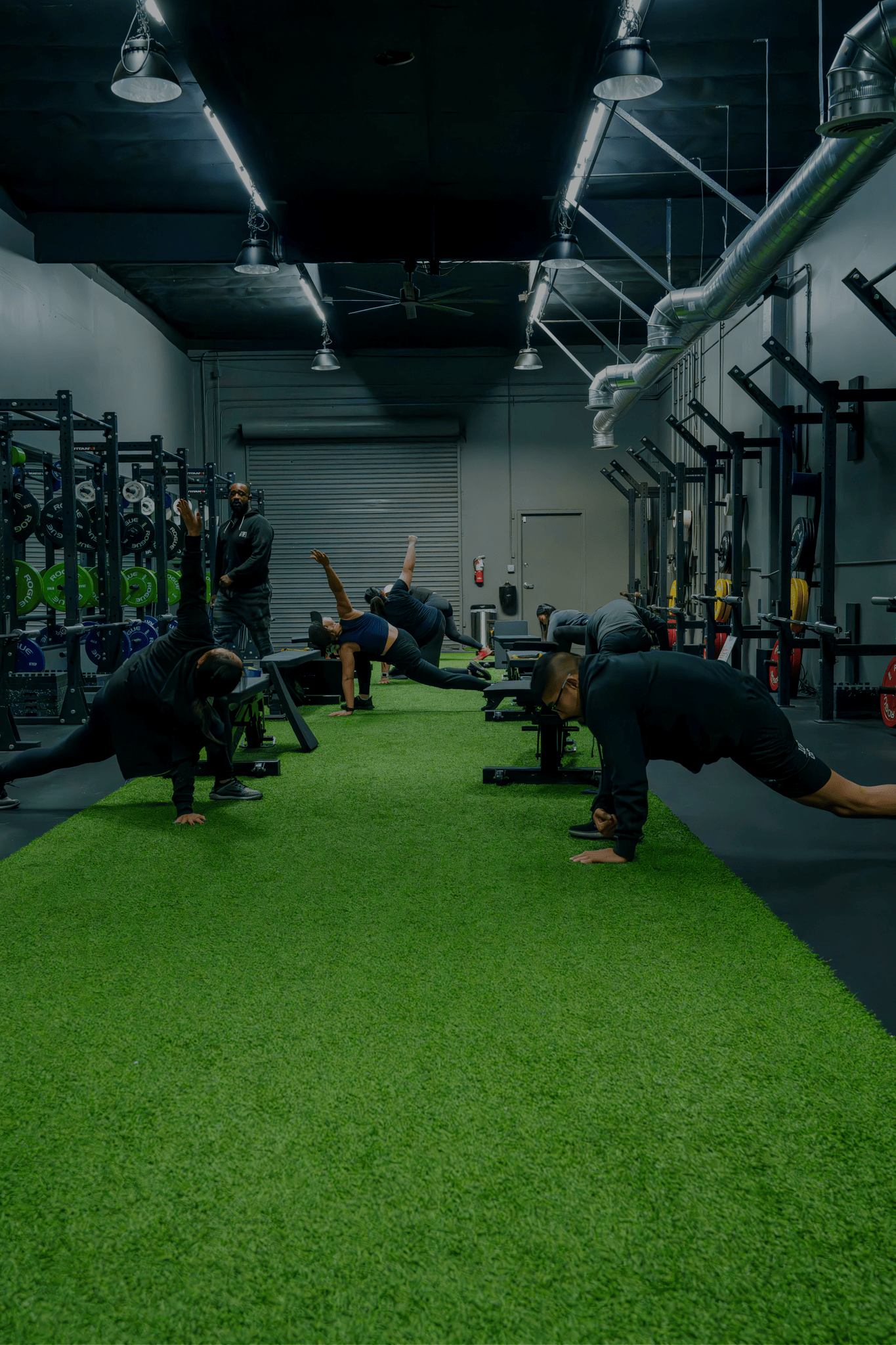
Passive recovery is full rest with no structured training, sleep, light mobility, maybe some stretching. Active recovery is gentle movement that improves circulation without adding stress. For example: Walking, easy cycling, yoga, slow swimming.
The science supports active recovery for clearing metabolic byproducts. A study published in the Journal of Sports Sciences found that active recovery cleared blood lactate significantly faster than passive recovery after intense running, with the most efficient clearance occurring at 60–100% of lactate threshold (Menzies et al., 2010). The catch is intensity. If it feels like a workout, it probably is. Passive recovery gives joints, tendons, and the nervous system a real break.
Beginners usually need more full rest since their bodies aren't conditioned yet. More advanced trainees can tolerate active recovery more often, but even high-level athletes still schedule full rest days. The point isn't doing less it's doing what holds up over time.
How Many Rest Days Should You Take Each Week
Most people need 1-2 rest days per week, depending on training intensity, sleep quality, age, and overall stress levels. Beginners often benefit from 2-3 rest days while their bodies adapt. Advanced trainees may rotate stress across muscle groups instead of taking full off-days, but elite athletes schedule planned recovery.
Use deload weeks to your advantage. Every few weeks, drop volume or intensity for a couple days. Fatigue will drop and performance will rebound. If you skip deloads long enough, and plateaus tend to show up.
How Long Should Each Muscle Group Rest Before Training Again
Knowing how many rest days to take is important so that you know what your body needs before it's ready to go again.
Research shows 48 to 72 hours between sessions hitting the same muscle group. A 2016 meta-analysis in Sports Medicine found that training each muscle group twice per week led to more growth than once per week when total volume was the same (Schoenfeld et al., 2016). The 2 times per week frequency naturally spaces out enough recovery between sessions.
However, compound lifts like squats, deadlifts, and heavy presses create way more total fatigue than curls or lateral raises. A heavy squat day doesn't just fry your quads, Iitt hammers your glutes, lower back, core, and taxes your central nervous system. So the muscles around the main target might need more time, even if they weren't the focus.
That's why training splits exist. Push/pull/legs spaces things so chest and shoulders recover while you're training back and biceps. Upper/lower splits do the same thing with fewer days. Full-body programs work when you're only training three days a week because each muscle gets enough rest before it comes back around.
Where people get tripped up is stacking sessions that overlap without thinking about it. Heavy rows on Monday and deadlifts on Tuesday? That's loading your entire posterior chain two days in a row. On paper those are different exercises. In reality, the same tissues are taking the hit both days. Think movement patterns, not just muscle names.
Your body gives you the answer if you pay attention. If soreness from a session hasn't cleared up by the time that muscle group comes back around in your program, something needs to change. Add a day between those sessions, pull the volume back on one of them, or swap the order so there's more space. The program should fit your recovery, not the other way around.
Sleep, Nutrition, and Stress: The Recovery Triangle
Bad sleep can't be out-trained.
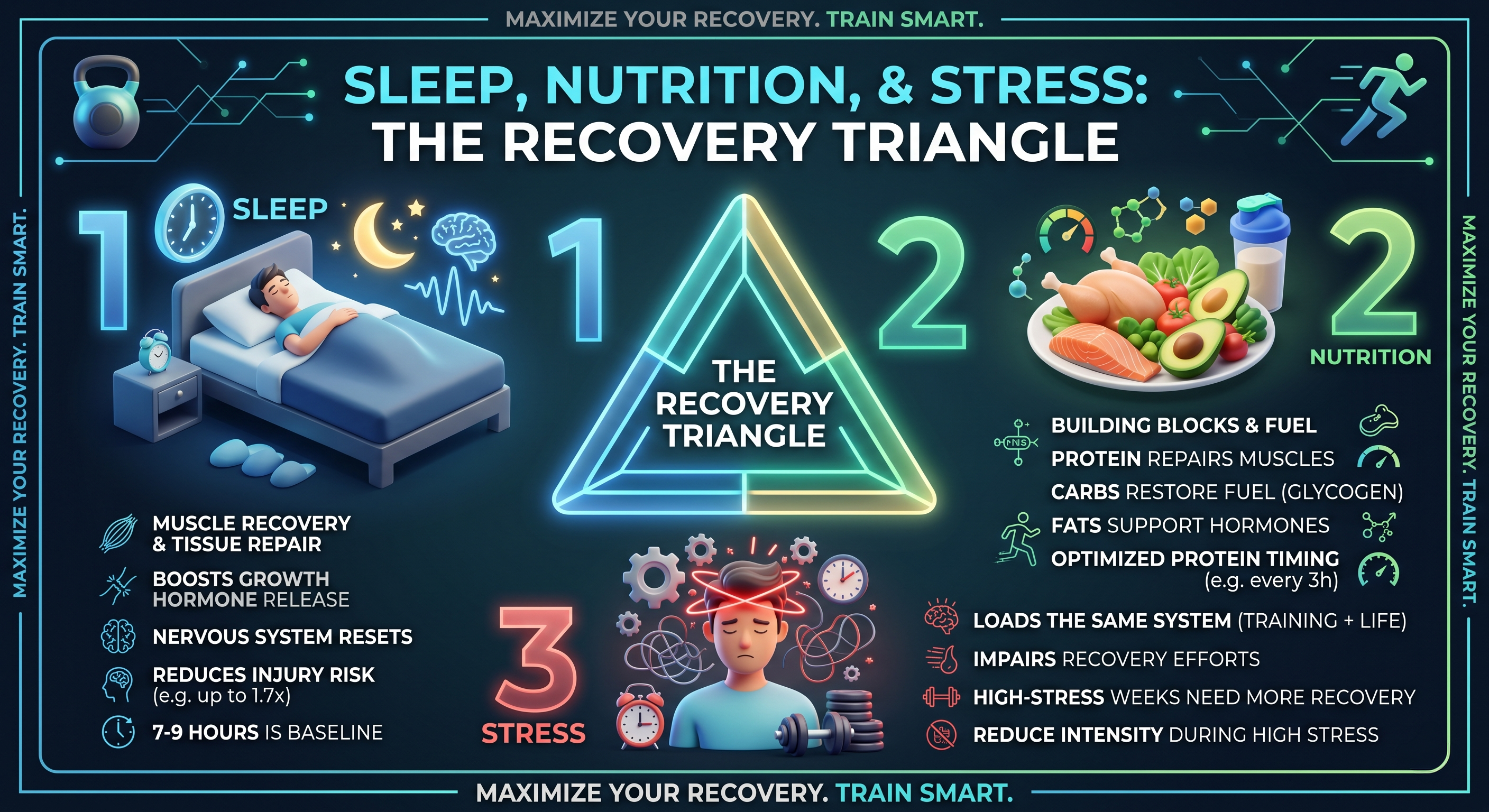
Sleep is where muscle recovery actually happens. Growth hormone releases, tissue repairs and your nervous system resets. The data on this is actually striking. A landmark study of adolescent athletes found that sleeping less than 8 hours per night increased injury risk by 1.7 times compared with athletes who slept more (Milewski et al., 2014). In a separate study of NCAA Division I basketball players, each additional hour of sleep was associated with a 43% drop in next-day injury risk.
A 2025 systematic review and meta-analysis in Frontiers in Physiology confirmed that sleep deprivation produces measurable declines in athletic performance, impaired neuromuscular coordination, increased injury risk, and delayed recovery in both athletes and non-athletes (Wu et al., 2025). Seven to nine hours isn't a luxury, it's baseline.
Nutrition matters just as much. A study published in the Journal of Physiology found that 20 grams of protein consumed every 3 hours produced the best myofibrillar protein synthesis response over a 12-hour recovery window, outperforming both smaller, more frequent doses and larger, less frequent ones (Areta et al., 2013). Protein supplies building blocks, carbs restore fuel, and fats support hormones. Under-eating turns rest days into missed opportunities.
Stress complicates everything. Work pressure, emotional strain, constant stimulation. The body doesn't separate training stress from life stress. It all loads the same system. High-stress weeks usually need more recovery, not more intensity.

What to Do on Rest Days: A Practical Recovery Day Template
Rest days shouldn't turn into full couch days or all out training sessions. Find a nice middle ground.
Start with mobility work like arm circles, butterflies, thoracic rotations, or whatever was stiff from the week. You're not trying to get a workout in. You're just trying to move a little better and get some blood flowing.
Get a walk in somewhere during the day for about twenty to fourty minutes at a conversational pace. We use walking as a recovery tool. It gets circulation moving, helps clear metabolic waste, and doesn't add any real stress to your joints or nervous system
Eat protein like it's a training day. Recovery doesn't stop just because you didn't lift. Muscle protein synthesis stays elevated for 24 to 48 hours after a hard session, and your body needs the building blocks to actually do the repair work. Cutting back on food because you "didn't do anything today" is one of the most common rest day mistakes, especially for people who eat based on how active they feel.
Use the evening to set yourself up for better sleep. Dim the lights earlier than usual. Cut caffeine by early afternoon. Keep the room cool. Sleep is where the real repair happens, and rest days are honestly the easiest nights to get a full seven to nine hours because you're not dealing with a late training session or elevated cortisol from evening intensity.
So a solid rest day looks something like this: morning mobility, a walk during the day, consistent meals with enough protein, and winding down a little earlier at night. Nothing flashy. But it adds up fast.
How Rest Days Reduce Injury Risk and Extend Training Lifespan
Injuries usually build slowly, through overuse, accumulated fatigue, and ignored signals. Tendons and ligaments adapt slower than muscles, which creates problems when volume increases without recovery.
Rest days give inflammation time to settle. Tissues remodel instead of breaking down. That matters most in high-impact training, running, Hyrox, CrossFit, heavy lifting. The injury data is consistent across sports: collegiate athletes sleeping 6 to 9 hours per night showed significantly fewer injuries than those sleeping less, and impaired neuromuscular control from sleep loss directly elevates injury risk (Charest & Grandner, 2020).
Age plays a role, as well. Many older trainees make better progress with fewer sessions and better recovery. The point isn't only chasing PRs, It's staying active long enough to care about them.
How to Tell If You Need One Rest Day or Two This Week
Most programs prescribe a fixed number of rest days, but recovery needs aren't fixed. A week with poor sleep, high work stress, or a lingering cold doesn't recover the same as a clean week where everything lines up. Sticking rigidly to one rest day when the body clearly needs two isn't discipline. It's just ignoring feedback.
A quick self-check at the start of each week helps. Ask four questions.
First, how did sleep go over the past few nights? If multiple nights fell below seven hours or sleep quality was broken, the system is already behind. Recovery starts with sleep, and a deficit doesn't vanish because the alarm went off.
Second, is there lingering soreness from last week that hasn't cleared? Normal post-training soreness fades within 48 hours for most people. If it's still hanging around heading into a new week, the tissue hasn't fully repaired and adding load on top of it just extends the problem.
Third, how is stress outside the gym? Heavy work weeks, emotional strain, travel fatigue. The body processes all stress through the same system. A week loaded with non-training stress usually means training tolerance drops, even if nothing changed in the program.
Fourth, how did the last few sessions feel relative to the numbers? If weights that normally move well felt heavy or conditioning work felt harder than the pace justified, that's a recovery signal. Performance dipping without a programming reason usually points back to insufficient rest.
If two or more of those check negative, take the second rest day. It's not lost progress. It's preventing the kind of slow-building fatigue that costs more time down the road than one extra day off ever would.
Signs You're Not Recovering Enough
Watch for these signals:
- Lingering soreness that doesn't fade between sessions
- Sleep getting worse even when going to bed early
- Mood shifts, irritability, or low motivation
- Warm-ups feeling heavier than they should
- Heart rate spiking faster on familiar work
- Weights feeling glued to the floor
- Minor injuries that won't fully heal
- Dreading workouts that used to feel exciting
Ignoring these isn't discipline, it's stubbornness. When training feels like something to dread instead of something to anticipate, recovery is often missing. Rest brings back sharpness, confidence. That urge to train without forcing it.
Frequently Asked Questions About Recovery and Rest Days
How many rest days should I take each week?
Most people need 1-2 rest days per week. Beginners often need 2-3. Advanced trainees may rotate intensity across days instead of taking full off-days.
Can I still be active on rest days?
Yes, if it stays easy. Walking, stretching, mobility work, and light yoga all qualify as active recovery. Research shows active recovery clears blood lactate faster than complete rest, but only when intensity stays at or below lactate threshold (Menzies et al., 2010).
Will rest days slow my progress?
Usually the opposite. Studies show that resistance exercise sessions performed with insufficient recovery (under 24 hours) fail to fully activate muscle protein synthesis, even when training volume and intensity stay constant (Ogasawara et al., 2017). Skipping rest tends to stall progress, not accelerate it.
What are the signs I'm not recovering enough?
Lingering soreness, declining sleep quality, mood shifts, slower performance, and minor injuries that don't fully heal. Several of these together usually means recovery is the issue, not effort.
Is sleep really that important for muscle recovery?
Yes. A study of NCAA Division I athletes found each additional hour of sleep correlated with a 43% reduction in next-day injury risk. Adolescent athletes sleeping under 8 hours per night had 1.7 times higher injury rates than peers sleeping more (Milewski et al., 2014). Seven to nine hours is the baseline.
What's the difference between active and passive recovery?
Passive recovery means full rest with no structured movement. Active recovery means gentle movement like walking, easy cycling, or yoga that boosts circulation without adding training stress.
Train Smarter. Recover Better. Get Results That Last.
Rest days aren't a weakness. They're understanding.
Progress depends on balance, muscles rebuild during rest, hormones reset during sleep, joints heal when stress pauses. If you skip recovery and results quietly fade.
Sustainable training isn't about grinding nonstop. It's about knowing when to push and when to step back. Treat rest days like training days with a different goal. Let the body do what it's designed to do. Adapt. Rebuild. Keep going.
If progress has stalled, soreness is sticking around, or motivation feels gone, recovery is probably the missing link. Start prioritizing rest days, smarter recovery strategies, and long-term performance now. Future training depends on it.
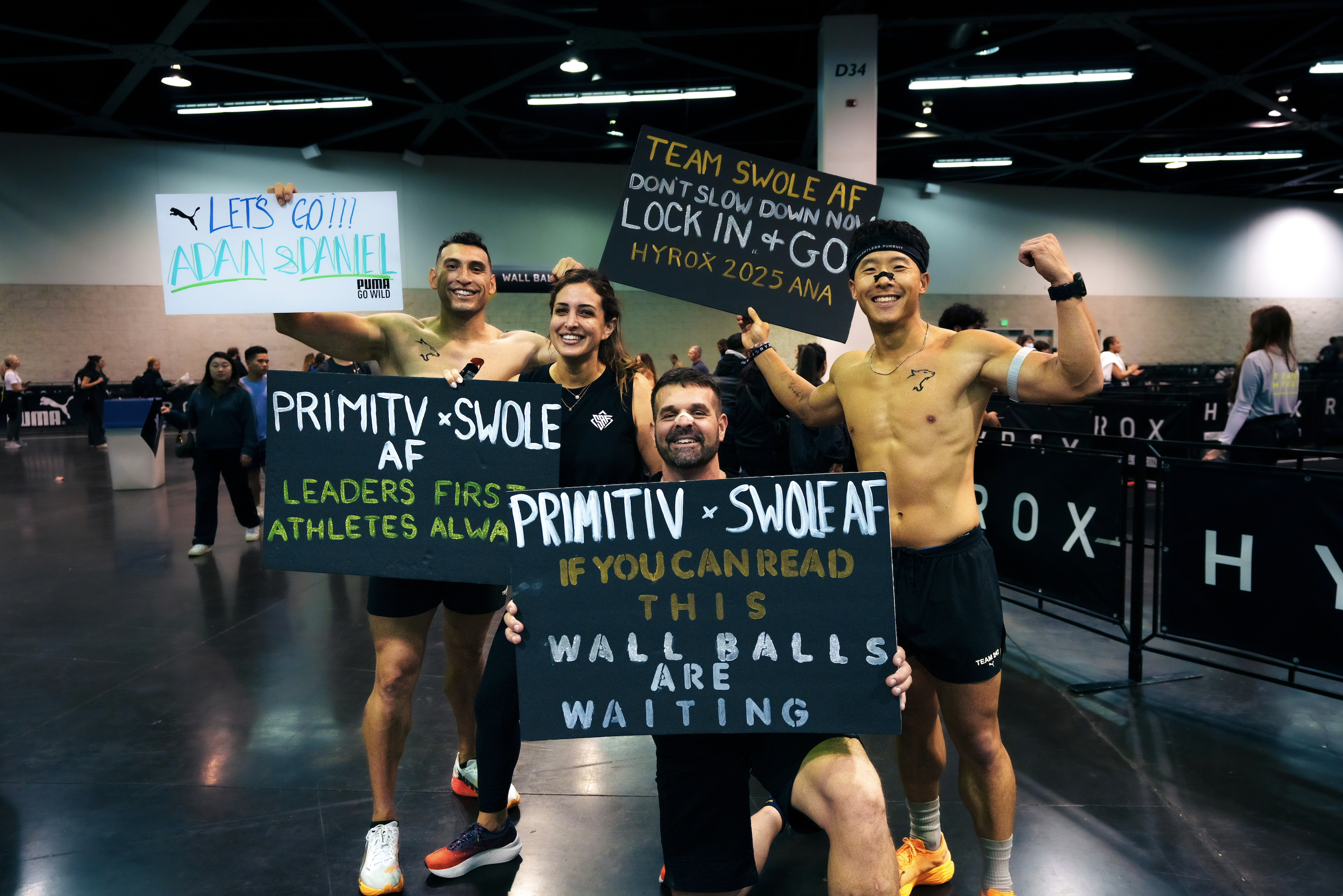
If you're thinking of doing Hyrox; or looking for a boutique 24/7 Private Gym
At Primitive x SwoleAF in Garden Grove, we run HYROX-specific programming every single week. Sled pushes. Sled pulls. Rowing. Wall balls. Lunges. All of it. Coached. Structured. With people who are training for the same thing you are.
Your first class is free. No commitment. No pitch. No nonsense. You show up, you train, you decide if it's for you.
If it is, welcome. If it's not, you still got a free workout and you leave better than you came in. There is literally no downside.
---
References
1. Milewski, M.D., Skaggs, D.L., Bishop, G.A., Pace, J.L., Ibrahim, D.A., Wren, T.A.L., & Barzdukas, A. (2014). Chronic lack of sleep is associated with increased sports injuries in adolescent athletes. Journal of Pediatric Orthopaedics, 34(2), 129–133.
URL: https://pubmed.ncbi.nlm.nih.gov/25028798/
2. Cadegiani, F.A., & Kater, C.E. (2017). Hypothalamic-Pituitary-Adrenal (HPA) Axis Functioning in Overtraining Syndrome: Findings from Endocrine and Metabolic Responses on Overtraining Syndrome (EROS)—EROS-HPA Axis. Sports Medicine - Open, 3(1), 45.
URL: https://pmc.ncbi.nlm.nih.gov/articles/PMC5722782/
3. Menzies, P., Menzies, C., McIntyre, L., Paterson, P., Wilson, J., & Kemi, O.J. (2010). Blood lactate clearance during active recovery after an intense running bout depends on the intensity of the active recovery. Journal of Sports Sciences, 28(9), 975–982.
URL: https://pubmed.ncbi.nlm.nih.gov/24739289/
4. Ogasawara, R., Arihara, Y., Takegaki, J., Nakazato, K., & Ishii, N. (2017). Repeated bouts of resistance exercise with short recovery periods activate mTOR signaling, but not protein synthesis, in mouse skeletal muscle. Physiological Reports, 5(17), e13350.
URL: https://pmc.ncbi.nlm.nih.gov/articles/PMC5704086/
5. Areta, J.L., Burke, L.M., Ross, M.L., Camera, D.M., West, D.W.D., Broad, E.M., Jeacocke, N.A., Moore, D.R., Stellingwerff, T., Phillips, S.M., Hawley, J.A., & Coffey, V.G. (2013). Timing and distribution of protein ingestion during prolonged recovery from resistance exercise alters myofibrillar protein synthesis. Journal of Physiology, 591(9), 2319–2331.
URL: https://pmc.ncbi.nlm.nih.gov/articles/PMC3650697/
6. Wu, Y., et al. (2025). Effects of sleep deprivation on sports performance and perceived exertion in athletes and non-athletes: a systematic review and meta-analysis. Frontiers in Physiology, 16, 1544286.
URL: https://www.frontiersin.org/journals/physiology/articles/10.3389/fphys.2025.1544286/full
7. Steinacker, J.M., Lormes, W., Reissnecker, S., & Liu, Y. (2004). New aspects of the hormone and cytokine response to training. European Journal of Applied Physiology, 91(4), 382–391.
URL: https://www.frontiersin.org/journals/network-physiology/articles/10.3389/fnetp.2021.794392/full
8. Charest, J., & Grandner, M.A. (2020). Sleep and Athletic Performance: Impacts on Physical Performance, Mental Performance, Injury Risk and Recovery, and Mental Health. Sleep Medicine Clinics, 15(1), 41–57.
URL: https://pmc.ncbi.nlm.nih.gov/articles/PMC9960533/
9. Damas, F., Phillips, S., Vechin, F.C., & Ugrinowitsch, C. (2015). A review of resistance training-induced changes in skeletal muscle protein synthesis and their contribution to hypertrophy.